About Me

Showing posts with label Idlewild Park. Show all posts

Thursday, September 13, 2012

Idlewild Park: Number 1 for Kids

Monday, September 13, 2010

On this date, Rock Springs’ sister park, Idlewild Park, in Ligonier, PA, was ranked number one for kids. Read more at http://rockspringspark.blogspot.com/2010/10/idlewild-park-named-1-kids-park.html.


Monday, July 23, 2012

Splish Splash

Many amusement parks today include a water park on their grounds to attract pleasure seekers looking for a fun way to cool off. At nearby Idlewild Park, in Ligonier, PA, the western lake-end along Route 30 is known as “SoakZone” and features a new wave pool called the “Wowabunga.” While Rock Springs Park never had a specific area exclusively set up and advertised as a “water park”, it did have a number of water-related attractions including the Crystal Pool, the Lake, the Shoot-the-Chutes ride with Splash Lagoon, and several cooling fountains and lily ponds.

Mirrored Rotating Fountain


Lily Pond

 
Shoot-the-Chutes


The Crystal Pool and Lake

Sunday, June 10, 2012

Virginia Gardens Baby Grand Was a Family Heirloom

Charles Clinton (C.C.) Macdonald and wife, Grace, owners of Summit Park in Akron, Ohio, purchased Rock Springs Park in 1926. Macdonald upgraded the aging Victorian park adding the Cyclone, a small zoo, and the Virginia Gardens Ballroom. For two seasons the park saw record attendance and profits, but with the onset of the depression, Macdonald needed to diversify in order to keep Rock Springs Park going. To that end, he moved his family to Ligonier, Pennsylvania in 1931 to become partner to Richard B. Mellon and part owner of Idlewild Park.

Grace Macdonald went back and forth between Rock Springs and Idlewild for four years until turning the entire operation of Rock Springs Park over to her newly-wedded daughter, Virginia, and son-in-law, Robert L. Hand, in 1935. The Hands would spend the next thirty-five years in Rock Springs Park, raising two sons and sustaining a modest but profitable existence until the park was purchased, rides and all, by the state of West Virginia in 1974.


During their years of operation and ownership of Idlewild Park, the Macdonalds lived in this home directly across Route 30 from the park. The home still stands today.


According to Tish Hand, “The fancy living room with the baby grand piano was in Grace and CC’s mansion in Idlewild. The piano came to Virginia Gardens after Grace's death (October 24, 1964) and was there for many years before the park closed. I don't remember what became of it, but it was offered to us and we had no place for it.”

As the baby grand is not listed among items to be auctioned off in this advertisement from the Beaver County Times, June 19, 1974, perhaps it was donated to a local church or sold to a local buyer prior to the auction. Does anyone know what happened to it?

(Click on image to enlarge.)


Thursday, July 14, 2011

Three Bears Born at Rock Springs Park

In his third year as manager of Rock Springs Park C. C. Macdonald kicked off the 1928 season with lots of advertising and articles which appeared in local papers. The ads led with the headline “Grand Opening – 1928” and included the motto “Ohio Valley’s Most Picturesque Playground – where the – Famous Rock Spring Flows.” The ad (left) also lists the many features and attractions at Rock Springs. “Many Rides and Amusements, Remodeled Crystal Pool and Boating, and Monkey Island and Goat Mountain.” That last bit refers to two features of a zoo which was located on the hillside above the upper park. (See Images of America: Rock Springs Park, p. 59) Roy Cashdollar spoke fondly of the “little zoo at the end of Lover’s Lane” and Richard (R.Z.) Macdonald told of the many animals he remembered in the zoo from his time growing up in the park. But it was not until I received the article below, from alert reader Jeff Schneidmiller of East Liverpool, OH, that I learned of black bears born in Rock Springs Park.

Source and Date Unknown

BLACK BEARS BORN AT ROCK SPRINGS PARK DURING WINTER

There being at this time only five breeding pairs of black bears in the United States, it is very doubtful if the public realizes the value of such a pair. However, their value seems to be a minor part in comparison with the life of their cubs.

The writer will attempt to give you a short history of Amos, Andy and Ruby, the three cubs, born at Rock Springs Park on the night of January 14th. In the past few years Queen, the mother bear, has been unsuccessful in raising her offsprings [sic]. So this past January, we took it upon ourselves to be mother and father to the little ones, taking them away from their mother when they were about a day old. After a few days, we found ourselves no easy task. We had to feed them with a bottle, and their diet was one of the most studious ones. It consisted of the following: --Skim Milk, Dextras Maltose No. 1, Lime Water, Castor Oil and Honey. At first, they refused the nipple, but as time wore on they took it readily every two hours, night and day. This necessitates two shifts on our part until now we have meal time down pat.

It was surprising how fast they grew. Weighing at the time of birth six ounces, they gained in weight and statue [sic] until now, fifty-eight days after birth, they are eight pounds in weight and as large as a good size poodle dog. At forty days, their eyes began to open, yet they were unable to see. Nature perhaps provides for this, as they are still rather weak in the knees to be walking around. When they will be able to walk and care of [sic] themselves remains to be seen. The night feeder hopes it won't be too long until that night comes when he doesn't have to get up in the cold and administer the bottle.

During the raising of the cubs, Lula, the other female, surprised us with one more cub, however, we decided to let her have the job of raising her own, she seems to be having as much success if not more than we are.

The writer just received word from the nursery, which will sadden the hearts of all concerned. Ruby, the largest, and seemingly the healthiest of all the litter has past into the great beyond, having contracted pneumonia. She died at 11:30 a.m. today. A fitting burial will take place tomorrow and little ruby will be laid to rest with all the pomp and ceremony due her kind.


Loowing [sic] in upon her two brothers, one seems to catch a quiet whine, which may be their crying for their dead sister, or they might be saying: "Come up and see me sometime next summer at Rock Springs Park.”

Jeff sent the above article along with the message, “Here is a another mystery to unravel.”

The mysteries seem to be "Who is the writer?" and "When did this event take place?".

A small zoo was added by C.C. Macdonald when he upgraded the park in 1926. In addition, his other park, Idlewild Park in Ligonier, PA, had a bear den that is still there today next to the roller coaster (see photographs below). Prior to that, C.A. Smith had a Hippodrome or circus-style theater somewhere in the park where elephants and other beasts performed, so the bears could have been born during his tenure as owner . On June 2, 1910, The Daily Times of Beaver, PA reported, “There is a fine bill at the Hippodrome, Rock Springs Park, this week, any of the acts being well worth the price of admission, including Carl Daman Family, Sensational Acrobats; the Orloff Troupe of Famous Russian Gymnasts and Roberti’s Bears, Dogs and Monkeys.”


The key to our latest Rock Springs Park mystery seems to be the names given our three bears: Amos, Andy and Ruby. The names are based on characters from the “Amos ‘n’ Andy Show," a situation comedy set in the African-American community which began on radio in 1925 and continued on television into the 1950s. Although the lead characters were black they were originally created and performed by Freeman Gosden and Charles Correll, white actors in black face familiar with minstrels, a theatrical tradition that would be considered beyond politically incorrect today. Naming black bears after stereotypical African American characters would be completely unacceptable and racist, but for our mystery, they do provide a time line for Jeff’s article.

Charles Correll ('Andy'-left) and Freeman Gosden ('Amos'-right) at a Chicago book signing, 1929.

Even though C.A. Smith had animal acts, including bears, at Rock Springs, his ownership does not fall within our timeline. It is only C.C. Macdonald and later his daughter Virginia and her Husband Bob Hand who could have been managers when the cubs were born. I’ve seen no evidence of animals in the park during the hand years, but do know, as I stated in my introduction, that Macdonald added a zoo when he upgraded the park in 1926. Further, I know him, or someone writing for him in this period, to be a writer who used details about the park to paint pictures in the reader's mind and always ended with an invitation; something that the writer of Jeff’s article clearly does.

Ruby Dandridge (March 3, 1899 – October 17, 1987) was an American actress from the early 1900s to the 1950s. She is best known for her radio work in her early days of acting, including her namesake character “Ruby” on the “Amos ‘n’ Andy” show. She is the mother of Dorothy Dandridge. (Ruby Dandridge Pictured at Right)

One other potential clue is the writer’s invitation to “Come up and see me sometime,” which may allude to Mae West’s famous line from She Done Him Wrong (1933). But when put in context and read completely, "Come up and see me sometime next summer at Rock Springs Park,” the invitation clearly does not fit with the suggestive nature intended by West’s character - Lady Lou.

So, does anyone know anything about these bears? From what I can gather, it may be from The Macdonald Years (1926 - 1934). If you have further details or thoughts, please leave a comment below.

Author (left) hanging with The Three Bears in Storyland, Stahlstown, PA, on Route 30 the Lincoln Highway in 1967.

Friday, June 24, 2011

Motor Square Garden

My foggy morning photographs do not do justice to this late Victorian office building in the East Liberty neighborhood of Pittsburgh. Known as "Motor Square Garden," it is a historic landmark which played an important role in the fate of not only Rock Springs Park but also Idlewild Park in Ligonier, PA.

After spending thousands of dollars upgrading Rock Springs Park in the late 1920s, owner C.C. Macdonald found himself in severe financial straits following the Stock Market Crash of 1929. He was desperate to find someone to lease the park as he was left penniless when the banks closed. When he could not find a lessee, he earned extra money working in the off-season at the Motor Square convention center in Pittsburgh. (See page 53 of Images of America: Rock Springs Park for a quote about this period from son R.Z. Macdonald.)

The construction of Motor Square Garden was financed by the Mellon family of Pittsburgh, it was built from 1898 to 1900 as a city market—after one of their real estate subdivisions failed to sell enough houses. Richard B. Mellon learned of C.C. Macdonald’s impressive amusement park experience and asked him to help improve Idlewild Park in Ligonier, PA, which he owned at the time. In order to diversify, Macdonald accepted Mellon’s offer and spent four years dividing his time between the sister parks. Eventually he would take on Idlewild fulltime and leave Rock Springs Park in the hands of his daughter Virginia and her husband, Bob.

In the 1920s, Motor Square Garden was used as a sports venue, especially for boxing, and was used intermittently as the home court of the University of Pittsburgh's basketball team.

In 1988, AAA bought the property. Landmarks Design Associates of Pittsburgh redesigned it as an upscale shopping mall. The retail mall failed, but AAA expanded to occupy the building, along with a tenant, the UPMC Shadyside School of Nursing.

Interior dome (from Landmarks Design Associates)

Interior commercial space (from Landmarks Design Associates)

FACT: The first ever broadcast of a sporting event occurred on April 11, 1921 at Pittsburgh’s Motor Square Garden when a 10-round, no decision fight between Johnny Ray and Johnny Dundee aired on KDKA.

Saturday, May 14, 2011

Say Hello to Summer Fun!

One of the fondest childhood memories shared by dozens of fans of Rock Springs Park at book signings and on the Web is of finding park tickets in their final report card envelopes. It’s a part of growing up in Chester and the surrounding area that I and my generation missed out on and one, I have to admit, of which I was a little jealous, until I realized that I have experienced a similar thrill in my adult life.


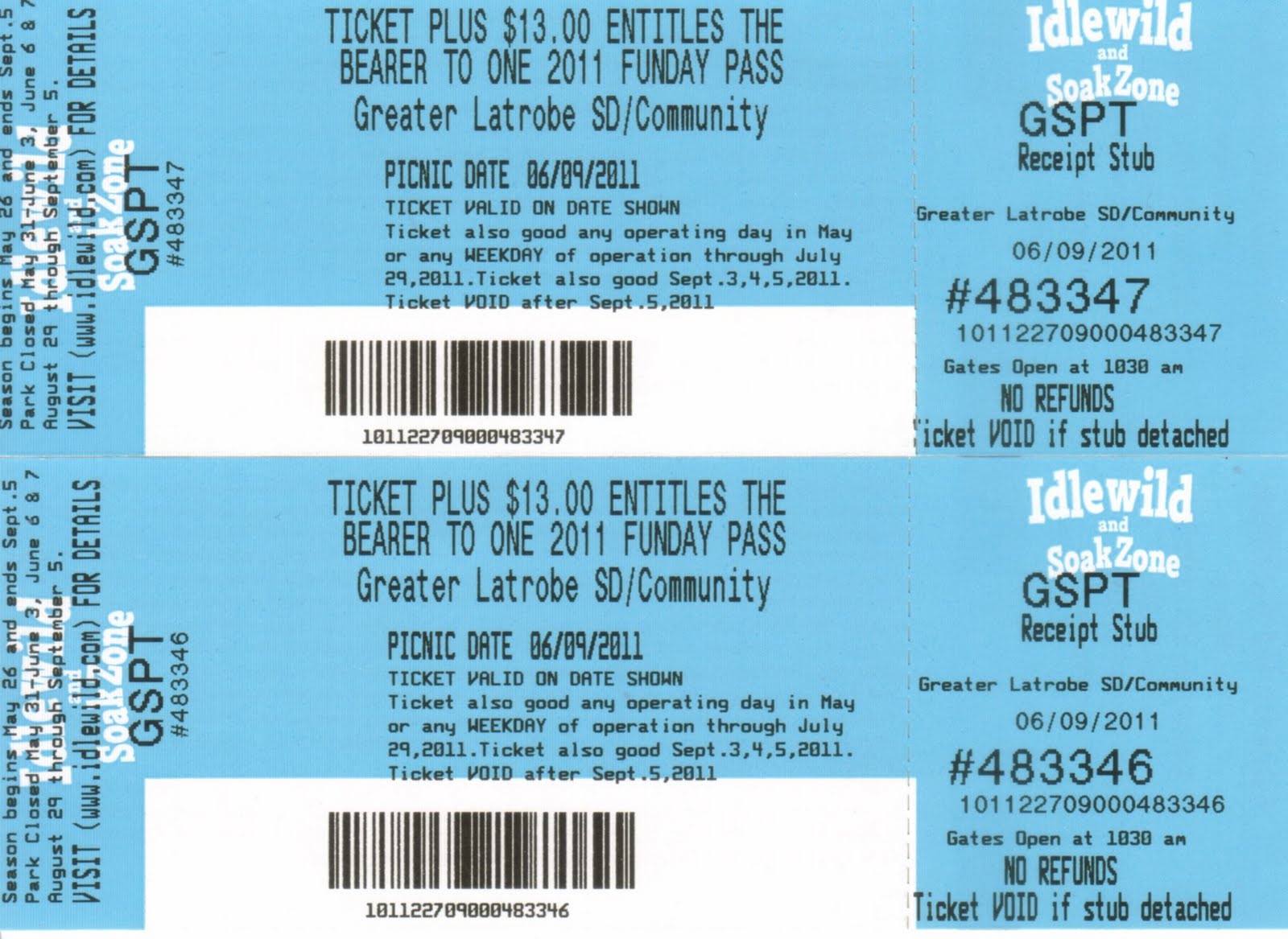
For twelve years I have been employed as a teacher with the Greater Latrobe School District and for each of those years I have found a small white envelope containing reduced price tickets to Idlewild Park in nearby Ligonier in my teacher mailbox. It’s one of many exciting signs that the school year is winding down and summer fun is just around the corner. School and community picnics like the one to be held at Idlewild on June 9 were also a huge part of Rock Springs Park’s success.


One-time Rock Springs Park booking manager, John Hickey told the Pittsburgh Press on May 16, 1954, “Over half of the picnics arranged at the park were for school children,” adding, “Youngsters of today behave exactly as they did when I began 33 years ago.”

In June of 1909, The Daily Times, Beaver, PA, reported that students were charged a uniform rate of 50 cents “in order that they may enjoy a more exclusive evening” on the night of their school picnic. At that time the main source of transportation to community days were trolley lines provided by the Ohio Valley Scenic Railway. Specials ran straight through to the park while regular cars required a transfer in East Liverpool. Tickets were sold at half price to all school children. These special trolley cars continued to carry picnickers to and from the park until 1934 when bus lines were then used.

Manager C.C. Macdonald in a “gesture of friendliness toward the community” in 1932 provided transportation to Rock Springs Park via special cars at “no charge” and gave each child five free amusement tickets. He also created “Bargain Day” the day before the community picnic in which all ride tickets were half price. The Daily Times stated, “Macdonald has always had a fine reputation for handling of large groups and the park employees are men who have been in this type of work for years and are noted for the way they handle children.”

In 1935, school students from Beaver, PA enjoyed a boat ride aboard the steamer, Washington, for their annual school outing. The steamer, capacity 2,000, had been carrying picnickers to the park since 1928. At that time there was an eight-piece orchestra, free dancing, and free ice cream onboard. Boat tickets in the twenties were priced at 15 cents for students and each child received four amusement tickets on the boat in addition to the number bought at school. “Price of amusement tickets at school or on the boat is two for five cents,” said the Daily Times. The Washington was eventually replaced by the new steamer, St. Paul, in 1937.


In June, when school is out for me, I will be thinking of those youngsters from a hundred years ago racing out of school with report card envelopes in their back pockets and strips of park tickets in the fists. It’s hard for me to imagine what it must have been like to have whole towns close down for a day of fun at Rock Springs Park as the article below from June 25, 1927 suggests, but is not difficult to imagine the thrill of school ending and summer fun beginning with the thoughts of all the smells, thrills, and excitement of a day at the park.

Sunday, April 3, 2011

What Led to the Demise of Rock Springs Park

If Rock Springs Park was still operating today, it would be the oldest amusement park in the United States. Although it officially opened on Memorial Day 1897, its history dates back to pre-Civil War picnics and prize-fights in 1857. The amusement park had been in continuous operation during the summer months (barring a few years during World War II) for more than 70 years when it closed for good after Labor Day 1970.

Just what really caused the decline of Rock Springs Park and led to its eventual demise in 1974, no one knows for sure. It is perhaps not any one reason, but more likely a combination of factors.

If the historic marker on Carolina Avenue is correct, the “automobile and changing social customs led to disuse and sale by 1970s."

Some say it was the tremendous increase in the use of the family automobile following WWII. Soldiers who had seen the world returned home and wanted to drive and see the country they served to protect. The car was their “escape vehicle” and allowed them to go anywhere they chose. They did not choose the neighborhood trolley park.

In Images of America: Rock Springs Park, I suggest that owner Bob Hand was politically connected and knew of the plans to remove the park in order to widen Route 30 and construct a cloverleaf approach to the new bridge long before 1970. Picture evidence backs this theory as it is clear the buildings in the park had not been painted for many years prior to its final season.

The Cyclone’s red letters were nearly completely faded from the loading platform in 1974.

The Arcade building in later years looked as if it had not been painted since the Macdonald’s upgraded the park in 1927.

Others say the park did not keep pace with times. With the opening of Disneyland in 1955, the new trend was toward theme parks like Freedomland in New York. Unlike Idlewild in Ligonier, Pennsylvania, which also faced a threat from a highway expansion project, Rock Springs Park was not in a resort area like the Laurel Highlands. Kennywood, another trolley park in Western PA, billed itself as “The Roller Coaster Capital of the World”, and continued to add modern coasters and water rides, while Rock Springs seemed frozen in the 1930s.


When I first heard about the park closing, I was in elementary school. I remember feeling sad. Like a lot of kids in town, I imagined that some rich guy would come along and make it a showplace once again. I especially wanted to see the carousel in operation again as my mother explained to me that it was still locked inside the pavilion and mentioned on more than one occasion how beautiful it was. By the time I was in 4th Grade at the old high school building and could reach out and touch the Cyclone and stare at the park from the kickball field, the park’s fate was locked in place. By the next year we heard and felt the dynamite blasts which shattered the age old rocks of Rock Springs Park into pieces.


Some people blame television for the demise of Rock Springs Park. This photograph of me (left) and my cousin Danny Ibbs (right) was taken at the new Beaver Valley Mall. I was more than happy to leave Chester and Rock Springs Park behind in December 1970 to meet Burt Ward of TV’s Batman. Parks like Kennywood took advantage of television’s popularity and hosted TV personalities such as The Lone Ranger and Timmy and Lassie.


Over the years, it was the company and community picnics which made the most money for the park. There is no question that these were in decline in the last ten years of operation. Paul H. Zender of the East Liverpool Review wrote, “Large Corporations, feeling the pinch of money needed for expansion, stopped holding traditional yearly get-togethers for employees and their families. Other special events simply didn’t draw crowds large enough to assure financial solvency.”


The more I learn about amusement park history, the more I have come to appreciate that Rock Springs Park lasted as long as it did. Most Victorian trolley parks did not survive beyond the Twenties due to the stock market crash. The Hands began operating the park in 1935 and kept it going longer than any previous owners. Ironically, the reason many were attracted to the park in later years was due to the fact that it hadn’t changed much in over 30 years. They wanted a chance to ride their old favorites from childhood.


Although the park has been gone for nearly 40 years, it still lives on in the hearts and minds of area residents. Images of America: Rock Springs Park is just one part of a larger conversation which keeps those memories alive. In the last chapter of the book, I discuss some of the ways others have preserved the history of the park with their stories, pictures and collections. Won’t you add your own thoughts by commenting below? Tell us your tale of Rock Springs Park.

Saturday, December 4, 2010

Rock Springs Park Attracts Folks from Western PA for the First Time in 40 Years


Last night I had my first signing at a major book store chain. I was at Barnes and Noble in Greensburg, PA, signing books and talking to folks about "chicken and waffles" (Rock Springs Park's signature dish/Pennsylvania Dutch treat), the Idlewild andMacdonald connection, and the fact that people from nearby Irwin, PA, made train excursions to the park in 1910 for fares under $2 a person. It was great to share Rock Springs Park's history with people in the area and to hear their stories of working in Rock Springs' sister park, Idlewild Park in Ligonier. Images of America: Rock Springs Park will now be available at the Greensburg store, including a number of signed copies.

Thursday, October 14, 2010

Idlewild Park Named #1 Kids Park

(Image courtesy of Richard Bowker)

For those who miss Rock Springs Park, the closest thing we have today is Idlewild Park in Ligonier, PA. Many people from Southwestern Pennsylvania who see pictures of Rock Springs Park in my book, often comment how much the buildings, like the ones pictured above, remind them of Idlewild. Both parks were owned and operated by C.C. Macdonald at one time. Proudly, Rock Springs' sisiter park was recently awarded the title of best children's amusement park in the world. Read more here.