About Me

Tuesday, August 9, 2011

A Unique Offer


In order to take control of the Upper Ohio Valley's baseball business, Rock Springs Park owner, C.A. Smith, and his partner, park manager J.H. Maxwell, came up with a "unique offer” to buy out their only competition - The East Liverpool Exhibition Company in 1908. The monies would be raised by offering fans $4.00 a share in the Ohio and Pennsylvania (O&P) League payable in ten admission tickets to the games at Rock Springs Park. In other words, if one were to purchase ten admission tickets to a game with a face value of 40 cents each, one could use those tickets to buy a single share of stock in the company, making the league one of the first partially community-owned franchises in American professional sports.

Sporting Life Magazine – May 9, 1908

Monday, August 8, 2011

South Side Land Company

To the right of Citizen's Drug Store in downtown Chester, WV, is a red brick building operating with two businesses in both sides. The first side had been Pettabon Ice Cream Parlor and then the original Citizen's Drug Store founded by Max Tuttle, followed by the State Liquor Store. The other side of the building was for many years used by Rock Springs Park owner, Mr. C.A. Smith, as his South Side Land Office and South Side Water Works Office. The building was purchased from Smith by E.G. Jackson who operated his insurance agency there for many years. It most recently housed the Pizza Roma Express Restaurant.

“South Side” refers to the name of the flat headlands of Chester by residents of East Liverpool, Ohio, to the north, before Chester had its name. One theory suggests Smith named Chester after his Uncle Chester Mahon.

"The South Side Land Company under Mr. C. A. Smith (Pictured below) absorbed the city’s water and sewerage systems. Mr. Smith controlled this company as the South Side Water Works until October 3, 1946, when Mayor DeMar Miller and City Clerk, James Paisley, signed for the City of Chester, when they purchased the company for $253,000. Mr. Thomas L. Young, Superintendent of the South Side Water Works for nearly forty years was retained as superintendent for the City." ~Roy C. Cashdollar's History of Chester: The Gateway to the West.


DeMar Miller before becoming Mayor of Chester was an orchestra leader at the world famous Virginia Gardens in Rock Springs Park circa 1928. (Image below courtesy of Jerry Linger. For more information on the band and Linger’s photograph see blog entitled “Facebook Find: Interior Photo of Virginia Gardens” dated Sunday, August 15, 2010.)
The Marks land, a one hundred seventy acre tract that had been bought by J.E. McDonald in 1890, from the Alfred Marks estate for $17,000, was purchased by Smith in 1900 with about eleven acres slated for use as Rock Springs Park which Smith also took over at this time. The land was then promoted by Smith and his South Side Land Company.
In the spring of 1905, Mr. Smith moved into his beautiful new home on Pyramus Avenue, overlooking Rock Springs Park.

Sunday, August 7, 2011

“Daredevil” Holden Appeared at Rock Springs Park in 1910


“Free Acts” were often daily features at Rock Springs Park during the C.A. Smith Era of 1900-1925. Acrobats and daredevils like Arthur C. Holden performed high wire and high diving stunts to hundreds of gaping on-lookers. Holden appeared at Rock Springs Park on Labor Day 1910, but he was world renowned according to features in New York and New Jersey newspapers of the day.
The South Amboy Citizen of October 5, 1912, advertised Holden's appearance at the Trenton Fair, "Arthur C. Holden, well named "Daredevil" Holden, in a backward dive into a small tank. Words cannot describe it - it must be seen.

Regardless of the Citizen’s claim, The New York Tribune did describe Arthur C. Holden's high diving exploits in its February 28, 1909 edition. "The afternoon exhibition came about 5 o'clock, and, following the announcement, the crowd sought vantage points and waited while the daring youth was hoisted to the roof in a boatswain's chair. Then a hush settled over the big amphitheater, so that one might have heard a pin drop as Holden stood poised for a minute on his small platform. Then the crowd burst into a cheer as, turning somersaults, the diver struck the water with a splash and swam out to bow his thanks." Holden's daredevil act was seen in New York as part of a Sportsman's Show inside Madison Square Garden.

Get a feel for the thrill of the high dive from the platform looking down in this video of an arm-stand high dive in Belgium.


Auto Racer in Rock Springs Park

One of my favorite rides in Kennywood Park, Pittsburgh, PA is the Auto Race. It is a fun and rather tame flat ride which allows your child to be the driver of an electric vehicle and puts you, the parent, in the backseat. Unlike Kiddie Turnpike Cars, Auto Race Cars are not limited by a groove or under auto rail. There is some steering control limited only by a trough-like wooden track. Kennywood’s Auto Race also known as the Auto Ride was built in 1930 by the Harry Traver Engineering Company and is the last of its kind. According to Wikipedia, “When it opened in 1930, it had several small hills placed in the track, but these were soon removed due to rear-end collisions caused when cars couldn't get up and over them on rainy days.”

Three years prior to Kennywood’s Auto Race, Rock Springs Park owner C.C. Macdonald drained the splash lagoon of the dismantled Victorian Shoot-the-Chutes Ride (above) and built a raised and twisting Auto Race wooden track within its walls.The photograph above shows the Auto Race track under construction in the splash lagoon pool.This image appeared on a brochure signed by then president of Rock Springs Park, C.C. Macdonald. The image has been enlarged to show riders in cars on the track. Notice the crowd viewing a high wire “free act” next to the Carousel.

A story was told to me at a book talk event which suggested previous owner C.A. Smith, when taking a test run on the Auto Racer in Rock Springs Park, crashed through the guardrail and was seriously injured. I have not been able to verify that story, but do know, if true, he must have fully recovered as he went on to raise prized cattle for several decades after.

See another image of the Auto Ride in Rock Springs Park in my Image book on page 59.

Saturday, August 6, 2011

River Excursions Past and Present

For our Oak Glen High School Prom in 1981, we were taken by bus to Pittsburgh to spend the evening dining and dancing aboard the Liberty Belle, part of the Gateway Clipper Fleet. Typical of an evening dinner/dance cruise of this type our diesel boat, resembling an old rear-wheel steam paddleboat complete with faux tall stacks, plied the Ohio and Monongahela Rivers cruising slowly back and forth always in sight of the beautiful evening skyline of the brightly lit city. I remember wishing at the time that our cruise to nowhere actually went somewhere, to a destination of some kind. A classmate suggested it would have been fun to return to Chester by boat, which led me to wish, as I often did, that Rock Springs Park was still around. We could have cruised home and spent the after prom at our own “Panhandle Playground” had the park not been sold and removed the previous decade.

Picnic dance excursions to Rock Springs Park aboard steam paddleboats were scheduled daily in the first half of the park’s existence. Many would come by train from Pennsylvania and Ohio to Rochester, PA and cruise to the park aboard the steamers Washington and St. Paul.

This ad from the Greensburg Daily Tribune features a train and boat excursion to Rock Springs Park in 1929.

My favorite images in the book are of the steamer Homer Smith docked along Pittsburgh’s Mon Wharf and subsequent departure in 1928. A large banner hanging from the middle deck reads, “ALL-DAY EXCURSION TO ROCK SPRINGS PARK." For many years company picnic cruises, like those from the Heinz Plant, to the park were annual events. (See Images of America: Rock Springs Park, pp. 56-57.)

It is interesting to note in the news brief (left) from the Pittsburgh Post-Gazette, August 6, 1915, that the Steamer St. James took passengers from Wellsville, Ohio, south and away from Chester and Rock Springs Park, normally just a short trolley ride, and cruised to Steubenville before heading north again to the park. This cruise for cruising sake reminded me of our prom night 66 years later.

Although, most of the Gateway Clipper Fleet trips today are evening cruises up and down the Three Rivers of Pittsburgh but never venturing far from the confluence, they do offer longer excursions, including a nine hour round trip to Steubenville. The next one is a fall foliage cruise in October.

PITTSBURGH to STEUBENVILLE CRUISE - Monday, Oct 10, 2011

Board: 9:30 AM
Depart: 10:00 AM
Return: 7 :00 PM

SAILING FROM PITTSBURGH TO STEUBENVILLE, THIS NINE HOUR TRIP ON THE OHIO RIVER FEATURES THE BEAUTIFUL COLORS OF FALL ALONG WITH FABULOUS LUNCH AND DINNER BUFFETS, GAMES, MUSIC, AND THE "VIVA LAS VEGAS REVUE".

Adult fare is $83.50 a slight increase in the $2.10 charged in 1929.

Friday, August 5, 2011

Orchestra Leader Also Ran Radio Repair Shop in Chester

"Eddie" McGraw was a “swing band” orchestra leader who played throughout the Tri-State Region of Pennsylvania, West Virginia, and Ohio. The advertisement (left) appeared in The Mansfield News-Journal, Mansfield, OH, on Monday, January 12, 1935.

I have seen articles and advertisements for Eddie McGraw’s Orchestra playing in Rock Springs Park and other venues, but did not realize, until recently rereading Roy C. Cashdollar’s History of Chester: The Gateway to the West, that Eddie lived and worked in Chester.

According to Cashdollar who was writing of a small building which sits across from the former City Hall on Carolina Avenue and Fourth Street, "(There were) two former occupants of the Jerry D'Angelo building. Max Beatty ran a small restaurant there for two years during the thirties and Eddie McGraw, who later became an orchestra leader quite popular in the tri-state area, ran a Radio Repair Shop for awhile before the building became a shoe repair shop."

I am old enough to remember the shoe repair shop of which Cashdollar wrote in 1976, and vaguely recall having a pair of shoes fixed at the shop as a small boy.

Cashdollar goes on to note two other facts about McGraw and the building which housed his repair shop, "Mr. McGraw played many times at Rock Springs Park, (and) an interesting note about the building is that the brick walls of it were constructed with paving bricks left over from the paving of Fifth Street by the E.A. Freshwater crew."
Advertisement (above) from The Livonia Gazette, Livonia, NY, Thursday, May 39, 1941, shows Eddie McGraw played New York and by this time lived in Cleveland, OH.

In the late thirties and early forties Eddie McGraw was known to play Long Point Park in New York State as a regular. An article from Livingston County Leader reported at this time, "Eddie McGraw will once again furnish his entertaining music for the opening of Long Point on May 28. This will mark his third season at the lake and there will be dancing every night after the opening." It goes on to explain that "Mr. McGraw is the husband of a Geneseo girl, the Former Peggy Mills." According to the article, prior to returning to his wife, who was spending several days with her parents, Dr. and Mrs. W.L. Mills back home in Geneseo, McGraw was broadcasting from WADC in Akron.

Geneseo, NY, is home to Long Point Park on the shores of Conesus Lake, one of the Finger Lakes.

I guess Eddie McGraw is no different than I and a lot of other Chester boys, who grew up in a small town that let us try anything and get away with nothing. I was interested in art and theater and Eddie was interested in his music. Our pursuits took us away from home and once out in the world we met new friends and colleagues, found girls, married, and settled near our wives' hometowns rather than our own.

Although I no longer live in Chester, researching and writing about the area and Rock Springs Park has brought me back and made me feel closer to my roots. Perhaps, playing music did the same for Eddie McGraw.

Thursday, August 4, 2011

Accident at Jethro Trestle

This image is identified as “Jethro Trestle” in East Liverpool's Carnegie Library archives. The underside of the trestle bridge appears in the background. The image shows the site of an accident, mentioned in my previous blog post, which occurred on December 8, 1906. The trolley pictured derailed due to "loose earth on the tracks" and plunged over a twenty-five foot embankment. The image shows debris strewn about the site and a line hoisting the damaged car back to the tracks above. The front of the car has been torn away.

This car and a small fleet of other trolleys serviced Rock Springs Park along the East Liverpool Traction & Light Company line.

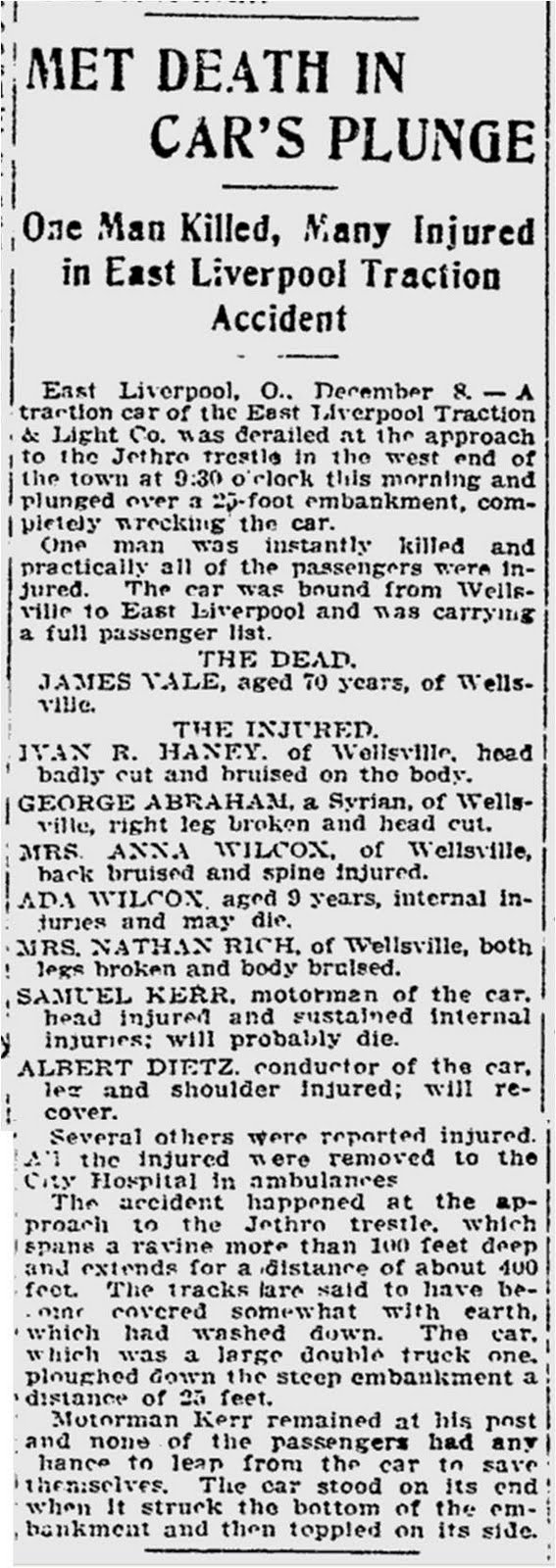
The article below, from the Pittsburgh Post-Gazette, December 9, 1906, provides further details on the accident and the injured. (Click image to enlarge or read transcript below.)

MET DEATH IN CAR'S PLUNGE
One Man Killed, Many Injured in East Liverpool Traction Accident

East Liverpool, O., December 8 - A traction car of the East Liverpool Traction & Light Co. was derailed at the approach to the Jethro trestle in the west end of the town at 9:30 o'clock this morning and plunged over a 25-foot embankment, completely wrecking the car.

One man was instantly killed and practically all the passengers were injured. The car was bound from Wellsville to East Liverpool and was carrying a full passenger list.

THE DEAD
JAMES VALE, aged 70 years, of Wellsville.

THE INJURED
IVAN R. HANEY of Wellsville, head badly cut and bruised on the body.
GEORGE ABRAHAM, a Syrian, of Wellsvillle, right leg broken and head cut.
MRS. ANNA WILCOX, aged 9 years, internal injuries and may die die.
MRS. NATHAN RICJ, of Wellsville, both legs broken and body bruised.
SAMUEL KERR, motorman of the car, head injured and sustained internal injuries: will probably die.
ALBERT DIETZ, conductor of the car, leg and shoulder injured will recover.

Several others were reported injured. All the injured were removed to the City Hospital in ambulances.

The accident happened at the approach to the Jethro trestle, which spans a ravine more than 100 feet deep and extends for a distance of about 400 feet. The tracks are said to have become covered somewhat with earth which had washed down. The car, which was a large double truck one, ploughed down the steep embankment a distance of 25 feet.

Motorman Kerr remained at his post and none of the passengers had any chance to leap from the car to save themselves. The car stood on its end when it struck the bottom of the embankment and then toppled on its side.