About Me

Saturday, August 6, 2011

River Excursions Past and Present

For our Oak Glen High School Prom in 1981, we were taken by bus to Pittsburgh to spend the evening dining and dancing aboard the Liberty Belle, part of the Gateway Clipper Fleet. Typical of an evening dinner/dance cruise of this type our diesel boat, resembling an old rear-wheel steam paddleboat complete with faux tall stacks, plied the Ohio and Monongahela Rivers cruising slowly back and forth always in sight of the beautiful evening skyline of the brightly lit city. I remember wishing at the time that our cruise to nowhere actually went somewhere, to a destination of some kind. A classmate suggested it would have been fun to return to Chester by boat, which led me to wish, as I often did, that Rock Springs Park was still around. We could have cruised home and spent the after prom at our own “Panhandle Playground” had the park not been sold and removed the previous decade.

Picnic dance excursions to Rock Springs Park aboard steam paddleboats were scheduled daily in the first half of the park’s existence. Many would come by train from Pennsylvania and Ohio to Rochester, PA and cruise to the park aboard the steamers Washington and St. Paul.

This ad from the Greensburg Daily Tribune features a train and boat excursion to Rock Springs Park in 1929.

My favorite images in the book are of the steamer Homer Smith docked along Pittsburgh’s Mon Wharf and subsequent departure in 1928. A large banner hanging from the middle deck reads, “ALL-DAY EXCURSION TO ROCK SPRINGS PARK." For many years company picnic cruises, like those from the Heinz Plant, to the park were annual events. (See Images of America: Rock Springs Park, pp. 56-57.)

It is interesting to note in the news brief (left) from the Pittsburgh Post-Gazette, August 6, 1915, that the Steamer St. James took passengers from Wellsville, Ohio, south and away from Chester and Rock Springs Park, normally just a short trolley ride, and cruised to Steubenville before heading north again to the park. This cruise for cruising sake reminded me of our prom night 66 years later.

Although, most of the Gateway Clipper Fleet trips today are evening cruises up and down the Three Rivers of Pittsburgh but never venturing far from the confluence, they do offer longer excursions, including a nine hour round trip to Steubenville. The next one is a fall foliage cruise in October.

PITTSBURGH to STEUBENVILLE CRUISE - Monday, Oct 10, 2011

Board: 9:30 AM
Depart: 10:00 AM
Return: 7 :00 PM

SAILING FROM PITTSBURGH TO STEUBENVILLE, THIS NINE HOUR TRIP ON THE OHIO RIVER FEATURES THE BEAUTIFUL COLORS OF FALL ALONG WITH FABULOUS LUNCH AND DINNER BUFFETS, GAMES, MUSIC, AND THE "VIVA LAS VEGAS REVUE".

Adult fare is $83.50 a slight increase in the $2.10 charged in 1929.

Friday, August 5, 2011

Orchestra Leader Also Ran Radio Repair Shop in Chester

"Eddie" McGraw was a “swing band” orchestra leader who played throughout the Tri-State Region of Pennsylvania, West Virginia, and Ohio. The advertisement (left) appeared in The Mansfield News-Journal, Mansfield, OH, on Monday, January 12, 1935.

I have seen articles and advertisements for Eddie McGraw’s Orchestra playing in Rock Springs Park and other venues, but did not realize, until recently rereading Roy C. Cashdollar’s History of Chester: The Gateway to the West, that Eddie lived and worked in Chester.

According to Cashdollar who was writing of a small building which sits across from the former City Hall on Carolina Avenue and Fourth Street, "(There were) two former occupants of the Jerry D'Angelo building. Max Beatty ran a small restaurant there for two years during the thirties and Eddie McGraw, who later became an orchestra leader quite popular in the tri-state area, ran a Radio Repair Shop for awhile before the building became a shoe repair shop."

I am old enough to remember the shoe repair shop of which Cashdollar wrote in 1976, and vaguely recall having a pair of shoes fixed at the shop as a small boy.

Cashdollar goes on to note two other facts about McGraw and the building which housed his repair shop, "Mr. McGraw played many times at Rock Springs Park, (and) an interesting note about the building is that the brick walls of it were constructed with paving bricks left over from the paving of Fifth Street by the E.A. Freshwater crew."
Advertisement (above) from The Livonia Gazette, Livonia, NY, Thursday, May 39, 1941, shows Eddie McGraw played New York and by this time lived in Cleveland, OH.

In the late thirties and early forties Eddie McGraw was known to play Long Point Park in New York State as a regular. An article from Livingston County Leader reported at this time, "Eddie McGraw will once again furnish his entertaining music for the opening of Long Point on May 28. This will mark his third season at the lake and there will be dancing every night after the opening." It goes on to explain that "Mr. McGraw is the husband of a Geneseo girl, the Former Peggy Mills." According to the article, prior to returning to his wife, who was spending several days with her parents, Dr. and Mrs. W.L. Mills back home in Geneseo, McGraw was broadcasting from WADC in Akron.

Geneseo, NY, is home to Long Point Park on the shores of Conesus Lake, one of the Finger Lakes.

I guess Eddie McGraw is no different than I and a lot of other Chester boys, who grew up in a small town that let us try anything and get away with nothing. I was interested in art and theater and Eddie was interested in his music. Our pursuits took us away from home and once out in the world we met new friends and colleagues, found girls, married, and settled near our wives' hometowns rather than our own.

Although I no longer live in Chester, researching and writing about the area and Rock Springs Park has brought me back and made me feel closer to my roots. Perhaps, playing music did the same for Eddie McGraw.

Thursday, August 4, 2011

Accident at Jethro Trestle

This image is identified as “Jethro Trestle” in East Liverpool's Carnegie Library archives. The underside of the trestle bridge appears in the background. The image shows the site of an accident, mentioned in my previous blog post, which occurred on December 8, 1906. The trolley pictured derailed due to "loose earth on the tracks" and plunged over a twenty-five foot embankment. The image shows debris strewn about the site and a line hoisting the damaged car back to the tracks above. The front of the car has been torn away.

This car and a small fleet of other trolleys serviced Rock Springs Park along the East Liverpool Traction & Light Company line.

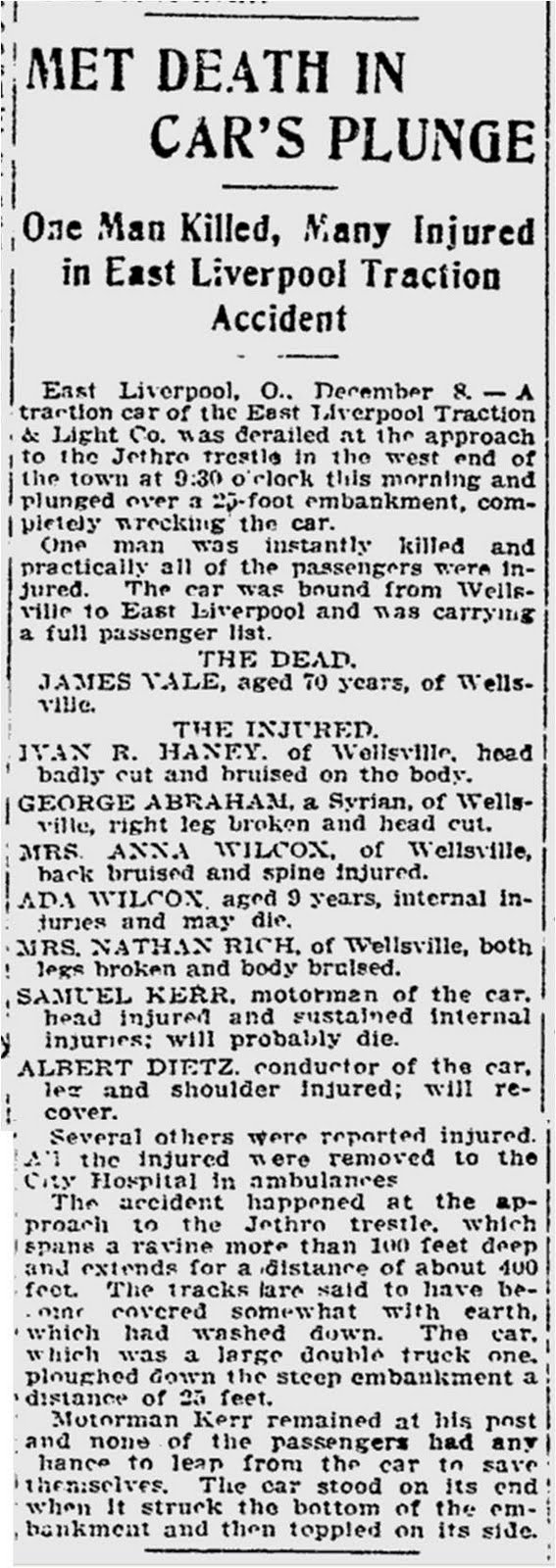
The article below, from the Pittsburgh Post-Gazette, December 9, 1906, provides further details on the accident and the injured. (Click image to enlarge or read transcript below.)

MET DEATH IN CAR'S PLUNGE
One Man Killed, Many Injured in East Liverpool Traction Accident

East Liverpool, O., December 8 - A traction car of the East Liverpool Traction & Light Co. was derailed at the approach to the Jethro trestle in the west end of the town at 9:30 o'clock this morning and plunged over a 25-foot embankment, completely wrecking the car.

One man was instantly killed and practically all the passengers were injured. The car was bound from Wellsville to East Liverpool and was carrying a full passenger list.

THE DEAD
JAMES VALE, aged 70 years, of Wellsville.

THE INJURED
IVAN R. HANEY of Wellsville, head badly cut and bruised on the body.
GEORGE ABRAHAM, a Syrian, of Wellsvillle, right leg broken and head cut.
MRS. ANNA WILCOX, aged 9 years, internal injuries and may die die.
MRS. NATHAN RICJ, of Wellsville, both legs broken and body bruised.
SAMUEL KERR, motorman of the car, head injured and sustained internal injuries: will probably die.
ALBERT DIETZ, conductor of the car, leg and shoulder injured will recover.

Several others were reported injured. All the injured were removed to the City Hospital in ambulances.

The accident happened at the approach to the Jethro trestle, which spans a ravine more than 100 feet deep and extends for a distance of about 400 feet. The tracks are said to have become covered somewhat with earth which had washed down. The car, which was a large double truck one, ploughed down the steep embankment a distance of 25 feet.

Motorman Kerr remained at his post and none of the passengers had any chance to leap from the car to save themselves. The car stood on its end when it struck the bottom of the embankment and then toppled on its side.

Trolley Car’s Wild Dash


The Chester Bridge in 1899. Trolley car crossing. (From East Liverpool Historical Society)

While recently viewing the 1972 film What’s Up Doc? with Barbara Streisand and Ryan O’Neal, I was reminded of my trips to San Francisco and cable car rides on the steep hills of the city. The picture ends with a wild street chase up and down San Francisco’s hilly terrain. This led me to wonder if the trolleys that ran to Rock Springs Park and traversed Chester, WV, and East Liverpool Ohio ever had to navigate such steep grades. With a little research I got my answer – A BIG “YES”.

The Chester trolley line would have been relatively flat, coming off the Chester Bridge on 1st Street then left on Virginia Avenue, right on 3rd, left on Carolina and onto the turnaround near Taylor Road and the Upper End. I imagined that East Liverpool’s route may have been more treacherous. In fact, J. E. McDonald built the bridge and created Chester, once the “South Side” of ELO, as an alternative to the hilly pottery town . My assumption about navigating the hills being dangerous was found to be correct upon discovering the story below. It recounts a trolley car’s deadly dash down a 25-foot embankment on the west end of town, and was featured in the New York Times on December 9, 1906.
Cable cars like those in San Francisco are built for hills. The driver turns a wheel or pulls a lever, in newer models, and grips the cable in a slot beneath the street and the car is pulled up the hill while clutching the moving cable driven by a powerhouse on the hilltop. Let go and hit the brakes to stop. Grab the cable and go again or let gravity pull you forward on the down grade. Electric streetcars, on the other hand, rely on overhead electric cables or a third rail beneath the car to supply electricity to a motor.
Cable Car diagram:
1. Emergency Brake Lever
2. Track Brake Lever
3. Wheel Brake lever
4. Grip Lever
5. Emergency Brake
6. Adjusting Lever
7. Grip
8. Bell
9. Rear Wheel Brake Lever
10. Track Brake
11. Wheel Brake
12. Cable

San Francisco Powerhouse showing cables in and out. (Illustrations from Cable Car Museum - 1201 Mason Street - San Francisco © 2004 - 2011 Friends of the Cable Car Museum)

Although the early electric trolleys were small, and not very powerful, they were still a lot faster than the horse cars they replaced.


When, in 1932, The Steubenville, East Liverpool & Beaver Valley Traction Company wanted to go to one operator per car in order to “offset a decrease in revenue”, The Trades and Labor Council listed the dangers of operating one-man interurban cars:

1. The cars are not equipped with the so-called “dead-man” control.
2. The line traverses hilly country where landslides are frequent.
3. Heavy fogs are frequently encountered.
4. There are many steep grades on the line.
5. Operators must give information to passengers and, on one-man cars, would be required to issue fare receipts and make change

The East Liverpool & Wellsville Street Railway began operations in 1892 serving the City of East Liverpool. In 1897 the railroad system was renamed the East Liverpool Railway and again in 1905 as the East Liverpool Traction & Light Company. This interurban operated for about ten years before changing hands again as the Steubenville, East Liverpool & Beaver Valley Traction Company, which it remained until 1939 when operations were discontinued in favor of buses.

Wednesday, August 3, 2011

Take the Yellow Car to Indian Rocks

Images of America: Rock Springs Park, page 9, mentions the advertisement (left) featured in Roy C. Cashdollar’s The History of Chester: Gateway to the West. It proclaims that readers should “TAKE THE YELLOW CAR” for a 15-minute trip to Smith’s Ferry, PA, and the site of Native American stone carvings along the banks of the Beaver River. Smith’s Ferry lies just east of the Ohio border near the point where the three states of Ohio, West Virginia and Pennsylvania meet.

The urgency in C.A. Smith’s advertisement was prompted by the soon-to-be completed Stratton Dam at New Cumberland, WV, which resulted in burying the ancient petroglyphs under ten feet of water.

Before Dam #8 was erected, the Ohio River was known to dry up at Smiths Ferry. During the dry summer season people traveled by horse and buggy, crossing over the river bed to view the ancient Indian relics. In the 1960s, a drought would allow visitors to view the petroglyphs once more below several inches of water.
(Julia Peck, Milestones Vol 22 No 2, Summer 1997)

The Yellow Car line is the one which served Smith’s Ferry. It started in Beaver, PA, and ran to Steubenville and was called the “Yellow Car Line” for the color painted on the eight street cars that served the route.

“Not far from the park, at the northernmost bend of the Ohio River, a great treaty was made between six powerful Indian nations. This council met at a large flat rock on the beach confirming their peace agreement by carving tribal symbols on the rock face.” Joseph A. Comm, Images of America Rock Springs Park, p. 9


Yellow Car from the Steubenville, East Liverpool & Beaver Valley Traction Co., Kuhlman Car built, 1915. (Caption data from Cliff Scholes, image from the Bill Volkmer collection.)

Syria Auto Club Route in Previous Post Was the Old Lincoln Highway


Curious about the route taken by the Syria Auto Club from West Carson Street in Pittsburgh to Rock Springs Park in 1928, I asked Lincoln Highway author, Brian Butko, about it.

ME: Brian, my latest blog post may interest you. It is about the first Syria Auto Club Picnic excursion to Rock Springs Park and includes an ad for the new line of “DeLuxe 1928 Oldsmobiles”. What road would they have traveled based on the description, “will proceed through Coraopolis, Carnot Sheffield, Monaca, Rochester, Beaver to East Liverpool and then to Rock Springs Park”?

BRIAN: Thanks, nice story. That's the original LH before it was rerouted in 1928 to what became US 30. At Beaver they would have likely followed the LH north via Tuscarawas Road to Fairview, Esther, and Ohioville before descending back down to Smith's Ferry.

The Lincoln Highway, named after our 16th president, was the first transcontinental highway across the United States of America. It was completed in 1915. The Lincoln Highway Route entered Pennsylvania crossing Little Beaver Creek and turned south on Main Street, passing under the Cleveland and Pittsburgh Railroad (PRR) into Glasgow. After passing through that community on Liberty Street, the highway turned north and passed under the railroad again at Smiths Ferry, merging with Smiths Ferry Road. This alignment through Glasgow carried the Lincoln Highway until 1926, when PA route 68 was built on the north side of the Pennsylvania Railroad.


Next Up: “Take the Yellow Car to Indian Rocks”, Smith’s Ferry, PA

Tuesday, August 2, 2011

1907 Merchants' Picnic Made Front Page Headlines

In July 1907 the headline "TOOK FOUR TRAINS TO CARRY CROWD" was front page news in The Beaver Daily Times. The story tells of record attendance to a hospital benefit picnic, a drowning which could not be confirmed, and a severe storm that left sand and gravel on trolley tracks delaying departure from Rock Springs Park to points north and east.

The Beaver County General Hospital, Rochester, was founded in 1899 as a semi-private institution. Shortly after it opened the name was changed to the Rochester General Hospital. On March 11, 1901, a fire partially destroyed the original building. With a state-obtained appropriation of $14,000, an equal amount was also raised through donations and benefits, like the picnic in Rock Springs Park, a modern building was constructed 1922.

The Daily Times - July 25, 1907

"Over Twenty-one Hundred People Attended Hospital Benefit Picnic at Rock Springs"

The Beaver County General Hospital Benefit and Merchants' picnic at Rock Springs Park yesterday, took more people out of Rochester and the lower valley towns than any other picnic excursion has done before. Over 2100 tickets were sold and instead of two trains four were required to carry picnickers to the park.

The first train left Rochester at 9 a.m., city time, followed by a second section a few minutes later. The 1:30 p.m. train also went in two sections. Except for having received a ducking, everybody was happy and thoroughly enjoyed the day.

A severe storm about four o'clock in the afternoon, somewhat marred the pleasure of the excursionists, and heavy rain washed considerable sand and gravel onto the street car tracks between the park and Chester, tying up traffic just about the time the first train was due to leave East Liverpool. A force of men were put to work cleaning up the debris and word was telephoned to the depot at East Liverpool, stating the condition of the tracks and requesting that the train be held until the cars resumed running, which was cheerfully done.

As a result of the rain the first train and the second section arrived in Rochester a little later than scheduled, but the train leaving East Liverpool at 11 p.m., city time, arrived on time.

Quite a number of picknickers, seeing the street car line tied up, walked to East Liverpool from the Park. Cabs and autos were at the disposal of any who preferred to ride and the prices were exorbitant. There were no accidents.

A report was current last night and today that a little girl had been drowned at the park yesterday but the rumor could not be verified. It is thought that someone hearing of the drowning of Mary McGonigle at Crows Run during the storm yesterday, got confused as to the place where the accident occurred, and this was responsible for the report.

The attendance at the picnic was far beyond the expectation of the committee in charge who deserve much credit for the success of the outing, and a nice sum of money will be realized for the benefit of the hospital.

Ducking - To submerge the head or body briefly in water.