About Me

Monday, August 15, 2011

Trinkets or Tradition?

Rock Springs Park Carousel

Ever wonder why carousels in the United States turn counterclockwise. I didn’t either, until I read that European carousels spin the other direction. I knew about the opposite toilet swirl in Australia and driving on the left side of the road in England, but opposing carousel twirls was something new to me. What’s up with that?

Carousel on London's South Bank during a summer festival.

On one of those “ask questions” sites someone speculated that a counterclockwise rotation reduces dizziness, but that is not the case. It seems that European merry-go-round horses face left to allow a rider to approach the horse or chicken or dragon directly from the loading platform and mount by lifting one's right leg over the animal's back. The horse's left side is called its "near" side, which is the side on which European riders traditionally mount. American carousels turn counterclockwise for a much less sophisticated reason. It is simply so that the rider on the outer ring can use his right hand to catch a brass ring. In other words, for them it's tradition and for us it's for trinkets.

Saturday, August 13, 2011

East Liverpool City Transit History

The East Liverpool City Transit System began in conjunction with a new bridge constructed by J.E. McDonald as part of an overall plan started in 1890 that was meant to connect East Liverpool, Ohio, to the “South Side” (Chester, WV) across the Ohio River and ending at Rock Springs Park.

Many trolley companies throughout the nation built amusement parks at the end of their lines to increase ridership on the weekends. In 1939, the streetcars were discontinued, replaced by buses of C.A. Smith’s Valley Motor Transit Company.

I mention this history in the book, but since I have spent several recent blog posts on the subject, I felt it would benefit readers to see a time line of the transit history:

1892-1897 - East Liverpool & Wellsville Street Railway
1897-1905 - East Liverpool Railway
1905-1917 - East Liverpool Traction & Light Co.
1917-1939 - Steubenville East Liverpool & Beaver Valley Traction Co.
1939 - Streetcars discontinued
1940-1954 - Valley Motor Transit Co.
1954-1971 - Steubenville Bus Co.

CURRENT TRANSIT SYSTEMS
Community Action Rural Transit System

Thursday, August 11, 2011

Mirrored Ball Still Turns


I had heard it rumored that the mirrored ball from Virginia Gardens Dance Hall in Rock Springs Park still turned during dances and wedding receptions held at the American Legion Post 121 in Chester. So, in November 2009, I stopped in and found Jack Sprout and some others hanging Christmas decorations. He gave me permission to take a few photographs for the last Chapter of my book, “The Magic Lives On”, and explained that the Legion purchased the ball at auction in 1974. (See Images of America: Rock Springs Park, p. 124.)


Entering the Legion was like stepping back in time for me because, 40 years earlier in 1969, it was where I attended kindergarten.

Wednesday, August 10, 2011

First Chester Graduation Held at Rock Springs

As if to illustrate the long connection between Rock Springs Park and the local school system, this image shows the parking lot of the old Chester High School transformed into an amusement fair next to the former site of the area’s “Premier Panhandle Playground” – Rock Springs Park.

A recent blog post about the changes to Chester High School over the years made me wonder about the time line of these changes and what was used for secondary education prior to the red brick building constructed by the Finley Brothers in 1928. So, I went to straight to my favorite source, Roy C. Cashdollar's History of Chester: The Gateway to the West for answers. Roy did not disappoint.

In 1906, the first full four-year high school building in Chester was erected at Third Street and Indiana Avenue. Prior to this structure, named Central School (pictured above), children met in homes or in one room buildings. These early schools were not graded, but in 1903, in anticipation of the new brick Central School, the first Chester freshman and sophomore classes were formed in a makeshift school building in town along the north side of Indiana Avenue between Third and Fourth Streets. Called the Mechanics Lodge, it also housed a general store and the post office.

Cashdollar notes, "the first high school graduation ceremony was held in Rock Springs Park on the stage of the old Summer Theater." The graduation class size that year was one, Olive Hamilton, who was the first and only Chester high school graduate in 1906. It was also the only time the theater was used for this purpose. The Summer Theater constructed in 1903 by C.A. Smith burned down in 1917 and was not replaced.

"When a special act of the legislature was made, Chester was organized as an independent school system in 1904. Thomas L. Young, who was the water works superintendent for C.A. Smith was one of the original board members." Roy C. Cashdollar.The Chester High School was constructed "on rather swampy lands" at the corner of Sixth and Indiana Avenue in 1925. It was officially dedicated on January 4, 1926. The original structure consisted of twelve rooms and two additions were added over the years with the largest one being done by through a W.P.A. project during the Depression.

With the construction of the Chester Primary Building (pictured with Rock Springs Park in the background in 1969) and Oak Glen High school in the early 1960s, the Central Building was abandoned in 1963 and razed in 1967, replaced with a playground which still displays the original school bell.

Tuesday, August 9, 2011

Jethro Trestle Image Update

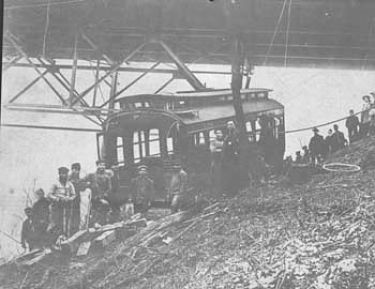
In two previous blog posts, I mention a tragic accident which occurred in East Liverpool, OH, in 1906, involving a traction car of the East Liverpool Traction & Light Co., which derailed at the approach to the Jethro trestle and plunged over a 25-foot embankment. I have since found two additional images of the trestle.


The trestle spanned a ravine more than 100 feet deep and extended for a distance of about 400 feet.
It appears, in the images above (Click images to enlarge), that Jethro Trestle connected the western edge of East Liverpool near the Ohio portal of today’s Newell Bridge and the City Hospital to “Sunny Side”, once considered the coal field of East Liverpool and now the home of East Liverpool Middle School and Patterson Field. The traction line continued beyond to Wellsville and Steubenville, OH.
The East Liverpool Middle School and Patterson Field in the old Sunny Side basin are still prone to flooding from the Ohio River.

Read all the dramatic details of the accident in my blog post of Thursday, August 4, 2011, entitled “Accident at Jethro Trestle.”

Memory Lane

While researching potential images and stories to share in the last chapter of Images of America: Rock Springs Park entitled, “The Magic Lives On,” I was told of a group of volunteers who were putting together a Memory Room in a classroom of the old Chester High School Building, now the City’s Municipal Building. The room, I discovered upon visiting in 2009, was originally set aside as the Mayor’s Office, but the mayor gave up his new “digs” and moved upstairs, opening up the classroom on the main floor to the Memory Lane Committee.

In my youth, the old high school was an intermediate/junior high, including grades four through nine. "Memory Lane" was my fifth grade language arts room. Specifically, I recall drawing a winter mural scene on the blackboard with a variety of colored chalk sticks. The teacher was enthusiastic about my artwork until it was discovered one of my dark green pieces of chalk was actually a fat crayon. I was worried upon entering the same room, thirty-four years later, that the blackboard would still be there, complete with my impossible-to-remove wax evergreens. Fortunately, though, the they have all been removed and, other than the view out the window, the classroom looks nothing like the one I remember. The intsitution green walls are now white.

View of the old high school beyond the Cyclone taken from the top of the Aeroplane Ride in Rock Springs Park circa 1947. The school is shown prior to an addition being added, which would house additional clasrooms and one day The Memory Lane Room. (Courtesy of Sherry Emery.)

When I took the photographs below inside the old high school in December 2009, I was using a low-grade disposable camera as I had forgotten my digital camera at home, thus most of the dark and grainy images were not used in the book. (I had hoped to take a photograph of the Memory Lane Volunteers, but we were not able to coordinate it. The women are listed in the book on page 127.) The Memory Room project was just getting started when these photographs were taken and would not officially open until June 21, 2010, coinciding with a slide show talk I gave in the cafeteria, sponsored by the Chester Kiwanis Club to kick off the publication of the book.

In the hallway outside my old Fifth Grade Language Arts class is the Chester Hall of Fame and Local History Displays. Inductee Plaques are hung above the display cases which were originally embedded with student lockers.

Inside the Memory Lane Room of the Chester City Building, two Hans Hacker paintings are on display. These were donated by Robert M. Hand, oldest son of owner Robert L. Hand. Bob willed the paintings to the city as per his mother Virginia’s wishes. The Log House (left) was once the family home of the Hands in Rock Springs Park. The second Hacker Painting is of the Carousel. Hacker, a celebrated decal and ceramic designer who fled Nazi Germany in 1939, painted hundreds of scenes of his new home, East Liverpool, OH, and the surrounding area.

Bob Hand, oldest son of Rock Springs Park owner Robert L. Hand is pictured in the hallway of the Chester’s City Building along with my mother, Margaret Cline, in the Chester High School Class Portraits of 1956.

My Grandfather, Clifford Otto Comm, a charter member of Chester's Kiwanis Club, was posthumously inducted into the Chester Hall of Fame on July 1, 2011. I was able to attend the ceremony, but have yet to see his plaque displayed along with the other inductees. I look forward to seeing it and Memory Lane again, soon!

Rock Springs Still Flows

I have written in past blog posts of The Chester Planning Commission. Founded in 1969, the civic group completed dozens of worthwhile projects in town including the installation of the “Rock Springs Park” historical marker and the development of the Virginia Gardens Memorial Park in 1982. Readers may not realize, however, that the planning commission, headed by Chester historian, Roy C. Cashdollar, also worked with state officials to save the spring at Rock Springs Park by having it piped to a new location along Route 30.
The Spring in 1974 just before it was covered with a cement slab and redirected.

Today, the lone spring pipe, bent by mowers, drains unceremoniously into a ditch near The World's Largest Teapot. For several decades after the park was razed in 1974, people would fill plastic bottles from the spring which once spilled 1,000 gallons a day from deep within the mountain into a basin in Rock Springs Park.
Rock Spring in 2009.

Cashdollar noted in his History of Chester: Part II, "Mayor Frank DeCapio and I went to the State men and the Contractors and convinced them to get the spring water piped to an area from which it can still be used. The old spring site is directly under the south bound lane of the highway today but it was covered with a cement slab and the water piped over to the open area near Marks Run."

1908 Postcard image of Rock Springs in Chester.